
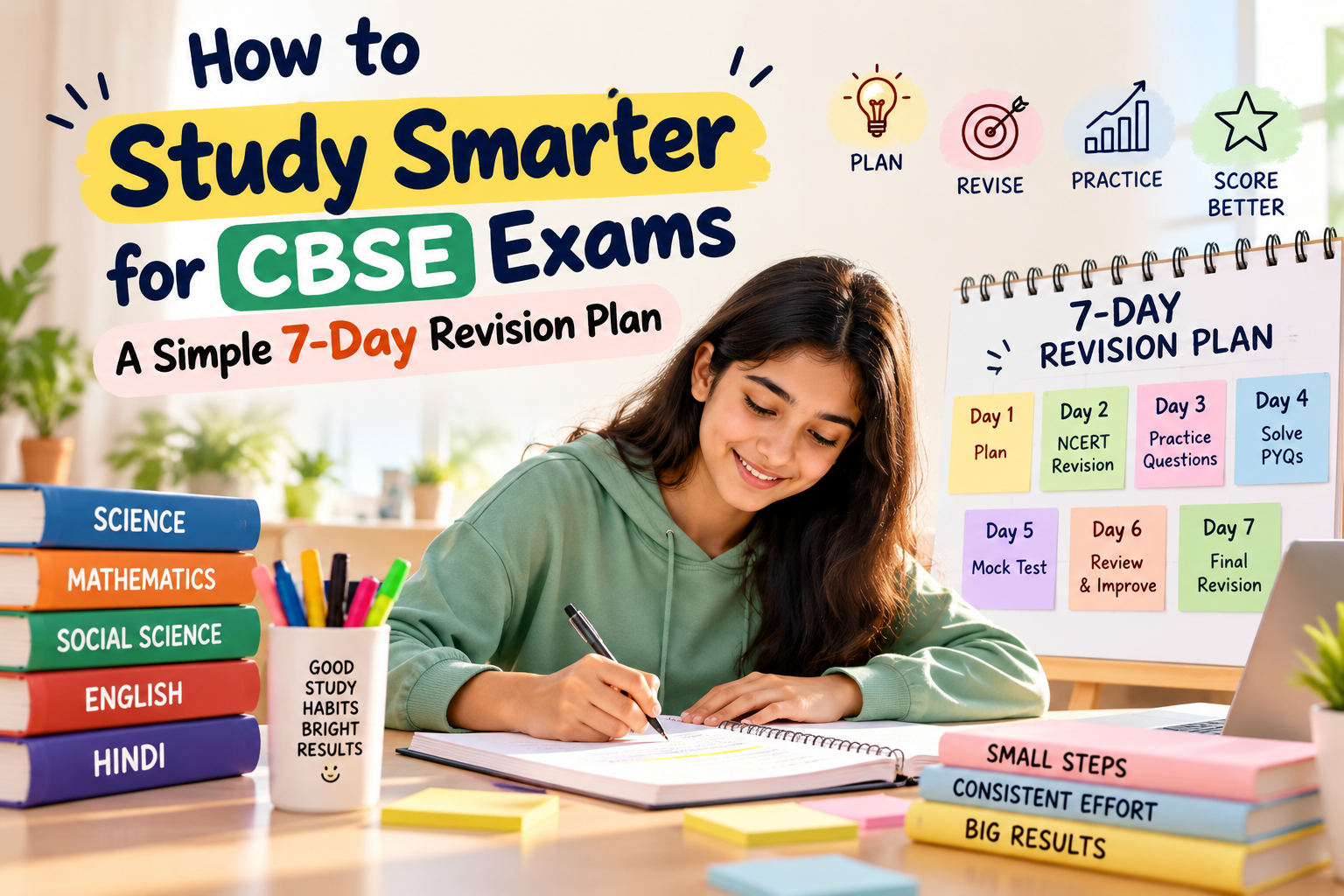
How to Study Smarter for CBSE Exams: A Simple 7-Day Revision Plan
Exams are approaching, your syllabus still feels huge, and you are not sure what to study first. Sound familiar?
Many students spend hours reading textbooks but still feel unprepared when they sit down to solve questions. The problem is not always a lack of effort. Sometimes, it is the way we study.
The good news? You do not need to study every waking hour to make progress. You need a clear plan, focused revision, regular practice, and enough time to learn from your mistakes.
In this guide, you will discover a practical 7-day CBSE exam revision plan that helps you revise NCERT concepts, practise questions, identify weak topics, and enter the exam with greater confidence.
Whether you are preparing for Class 10 or Class 12, you can adapt this plan to your subjects and available time.
Why Is a Revision Plan Important?
Without a plan, it is easy to spend too much time on familiar chapters while ignoring topics that need more attention.
A good revision plan helps you:
- Cover important concepts systematically.
- Identify weak areas before the exam.
- Practise questions instead of only reading notes.
- Improve recall through active revision.
- Reduce last-minute stress by knowing what to do each day.
Remember, the goal is not to finish as many pages as possible. The goal is to understand, remember, and apply what you have learned.
The 7-Day CBSE Exam Revision Plan
Day 1: Check Your Syllabus and Identify Weak Topics
Start by making a simple list of the chapters you need to revise for each subject.
Divide them into three categories:
Strong: You understand the concepts and can solve questions independently.
Needs Revision: You understand the basics but sometimes forget formulas, definitions, or steps.
Weak: You struggle to explain the concepts or answer related questions.
Begin with topics that need revision or are weak, while keeping enough time for important chapters you already understand.
For example, a Class 10 student might need to revise Chemical Reactions and Equations in Science while practising quadratic equations in Mathematics.
Do not spend the entire first day creating a perfect timetable. Make a simple plan and start studying.
Your Task: Prepare a chapter checklist and select three priority topics.
Day 2: Revise NCERT Concepts Properly
Your textbook should be the foundation of your revision, especially for CBSE subjects that follow NCERT closely.
Instead of reading a chapter repeatedly, try this method:
1. Read a small section carefully.
2. Close the book and explain the concept in your own words.
3. Write down important definitions, formulas, reactions, or dates from memory.
4. Reopen the book and check what you missed.
5. Mark the points that need another revision.
This method helps you find out whether you actually remember a concept rather than merely recognising it while reading.
For subjects such as Physics and Mathematics, work through examples step by step. For Biology, focus on processes, terminology, diagrams, and the relationships between concepts. For Social Science, connect important events, causes, consequences, and key terms.
Your Task: Revise two or three manageable topics and create short notes for difficult concepts.
Day 3: Practise Questions After Revision
Reading gives you familiarity with a topic. Solving questions helps you check whether you can use what you have learned.
After revising a chapter, attempt a short practice set without looking at your notes.
Try different question formats where appropriate:
- Multiple-choice questions (MCQs)
- Short-answer questions
- Numerical problems
- Definitions and explanations
- Diagram-based questions
- Long-answer questions
For example, after revising Electricity in Class 10 Science, practise numerical problems involving current, voltage, resistance, and electrical power.
If you get a question wrong, do not simply memorise the correct answer. Ask yourself why you made the mistake. Did you forget a formula, misunderstand a concept, misread the question, or make a calculation error?
Your Task: Complete practice questions from your priority chapters and record your mistakes.
Day 4: Focus on Your Weakest Areas
This is the day to work on topics you have been avoiding.
Review the mistakes from Day 3 and group them into categories:
- Conceptual mistakes
- Forgotten formulas or facts
- Calculation errors
- Misunderstood questions
- Incomplete answers
Choose the two or three most important problem areas and revisit them.
Break difficult chapters into smaller sections. If you struggle with a long topic, study one concept at a time and solve a few questions before moving forward.
You can also use flashcards for definitions, formulas, scientific terms, historical dates, and other facts that need regular recall.
Do not worry if your progress feels slower today. Correcting a misunderstanding can be more valuable than rushing through another chapter.
Your Task: Relearn your weakest concepts and attempt a fresh set of questions to check your understanding.
Day 5: Practise Under Time Limits
Knowing the answer and solving it within an exam's time limit are two different skills.
Start practising with a timer. Choose a chapter test or a mixed set of questions and try to finish within your planned time.
After completing the test, review:
- How many questions you attempted.
- How many answers were correct.
- Which questions took too long.
- Which topics caused repeated mistakes.
- Whether you left questions unanswered because of poor time management.
Do not focus only on your score. Use the results to decide what to revise next.
For students preparing for competitive exams such as NEET or JEE, timed MCQ practice is particularly useful for developing speed, accuracy, and question-selection skills.
Your Task: Complete at least one timed practice set and analyse your performance.
Day 6: Attempt a Mock Test and Analyse Your Results
Now bring your preparation together with a mock test or a sample paper appropriate for your class and exam.
Try to follow the actual examination conditions as closely as practical. Keep your phone away, avoid checking notes during the test, and use a timer.
When you finish, review every incorrect or uncertain answer.
Create a simple mistake log using the following format:
Question or Topic: Physics numerical
What Went Wrong: Used the wrong formula.
What to Do Next: Revise the formula and solve three similar problems.
Question or Topic: Biology concept
What Went Wrong: Confused two terms.
What to Do Next: Review the textbook explanation and make flashcards.
Question or Topic: Mathematics problem
What Went Wrong: Made a calculation error.
What to Do Next: Practise similar questions carefully.
A mock test is not just a way to measure preparation. It is a tool for deciding what to improve before the actual exam.
Your Task: Complete one suitable test, analyse the results, and revise the most important mistakes.
Day 7: Revise, Recall, and Rest
Avoid trying to learn the entire syllabus from scratch on the final day.
Focus on consolidating what you already know.
Review your short notes, important formulas, definitions, diagrams, common mistakes, and frequently forgotten concepts. Test yourself by recalling information before looking at your notes.
If possible, attempt a short quiz on your weaker chapters. Keep the session focused and avoid spending too much time on a single difficult question.
Prepare the materials you need for the examination and check your exam schedule.
Most importantly, get sufficient sleep. Staying awake all night can make it harder to concentrate, recall information, and manage time during the exam.
Your Task: Complete a light revision session, prepare for the next day, and allow yourself time to rest.
How Many Hours Should You Study Every Day?
There is no single number of study hours that works for every student. Your available time depends on your school schedule, current preparation, subjects, and the number of days remaining before the exam.
Instead of setting an unrealistic target, divide your available time into focused sessions.
For example, a student with three hours available might use this structure:
- 45 minutes: Revise a difficult concept.
- 10 minutes: Take a short break.
- 45 minutes: Solve practice questions.
- 10 minutes: Take a short break.
- 40 minutes: Study another subject.
- 30 minutes: Review mistakes and recall important facts.
Adjust this timetable to your needs. If you have more time, add another focused session. If you have less time, prioritise the chapters that require the most attention.
Consistency matters more than following someone else's timetable perfectly.
Five Common Revision Mistakes to Avoid
1. Reading Without Testing Yourself
Reading the same chapter repeatedly may feel productive, but it does not always show whether you can recall the information independently.
After each section, close your book and try to explain the concept or solve a related question.
2. Ignoring Mistakes
Repeatedly making the same mistake wastes valuable preparation time. Maintain a mistake log and revisit it regularly.
3. Spending Too Long on One Chapter
Do not let one difficult chapter consume your entire day. Break it into smaller topics, set a reasonable time limit, and return to it later if necessary.
4. Using Too Many Study Resources
Switching constantly between books, videos, notes, and websites can make revision confusing.
Start with your prescribed textbook and class notes. Add practice resources when they help you understand or test a concept.
5. Sacrificing Sleep for Last-Minute Study
An exhausted mind may struggle to concentrate and recall information. Build sleep and short breaks into your preparation plan.
How Padhaieasy Can Help You Revise Smarter
A structured revision plan becomes easier to follow when you have a way to practise, review, and track your progress.
Padhaieasy provides study tools that can support different stages of your preparation.
Create Practice Quizzes
Use the Padhaieasy AI Quiz Generator at https://padhaieasy.com/ to create quizzes around your selected subjects and topics. You can use standard quiz options for curriculum-based practice or custom materials where available.
Organise Your Revision
Use Padhaieasy Learn and Study Studio at https://padhaieasy.com/ to explore available learning materials, notes, flashcards, and chapter-based practice.
Practise for Competitive Exams
Students preparing for medical or engineering entrance examinations can explore the dedicated NEET preparation section at https://padhaieasy.com/neet and JEE preparation section at https://padhaieasy.com/jee.
For timed practice, explore the available NEET and JEE mock tests at https://padhaieasy.com/mock_tests.
Choose tools that support your learning instead of using every feature at once. Your main objective is to understand concepts, practise regularly, and learn from your mistakes.
Frequently Asked Questions
Is a 7-Day Revision Plan Enough for CBSE Exams?
A seven-day plan can help you organise revision and identify weak areas if you have already studied much of the syllabus. If you are starting from scratch or have several difficult chapters remaining, you will likely need more time.
Should I Study Every Subject Every Day?
Not necessarily. You can focus on one or two major subjects each day while spending a short session reviewing formulas, definitions, or previously studied topics. Make sure every subject receives enough attention before the exam.
Is Solving Questions Better Than Reading Notes?
Both are useful. Reading helps you understand concepts, while solving questions checks whether you can apply and recall them. A balanced revision plan includes both activities.
How Can I Remember Formulas and Definitions?
Practise recalling them without looking at your notes. Use flashcards, write formulas from memory, solve related problems, and revisit difficult items over several days.
Should I Take a Mock Test Before My Exam?
Yes, when it is appropriate for your class and examination. A mock test helps you practise time management, identify weak topics, and understand which mistakes need attention.
Final Thoughts
Effective exam preparation is not about studying every minute of the day. It is about making each study session purposeful.
Start by identifying your weak topics. Revise concepts carefully, practise questions, analyse your mistakes, and return to difficult areas until you understand them better.
Use this seven-day plan as a starting point and adjust it according to your syllabus, available time, and exam schedule.
Your Next Step: Choose one topic you find difficult, revise it today, and attempt five to ten practice questions. Small, consistent improvements can make your preparation more organised and effective.
Study smart, stay consistent, and keep moving forward with Padhaieasy.


